Faceless Reels vs YouTube Shorts: Which Pays More in 2026?
An honest comparison of Instagram Reels vs YouTube Shorts for faceless creators — covering monetization, algorithm differences, audience reach, and why posting to both platforms is the smartest strategy in 2026.
FlowShorts Team
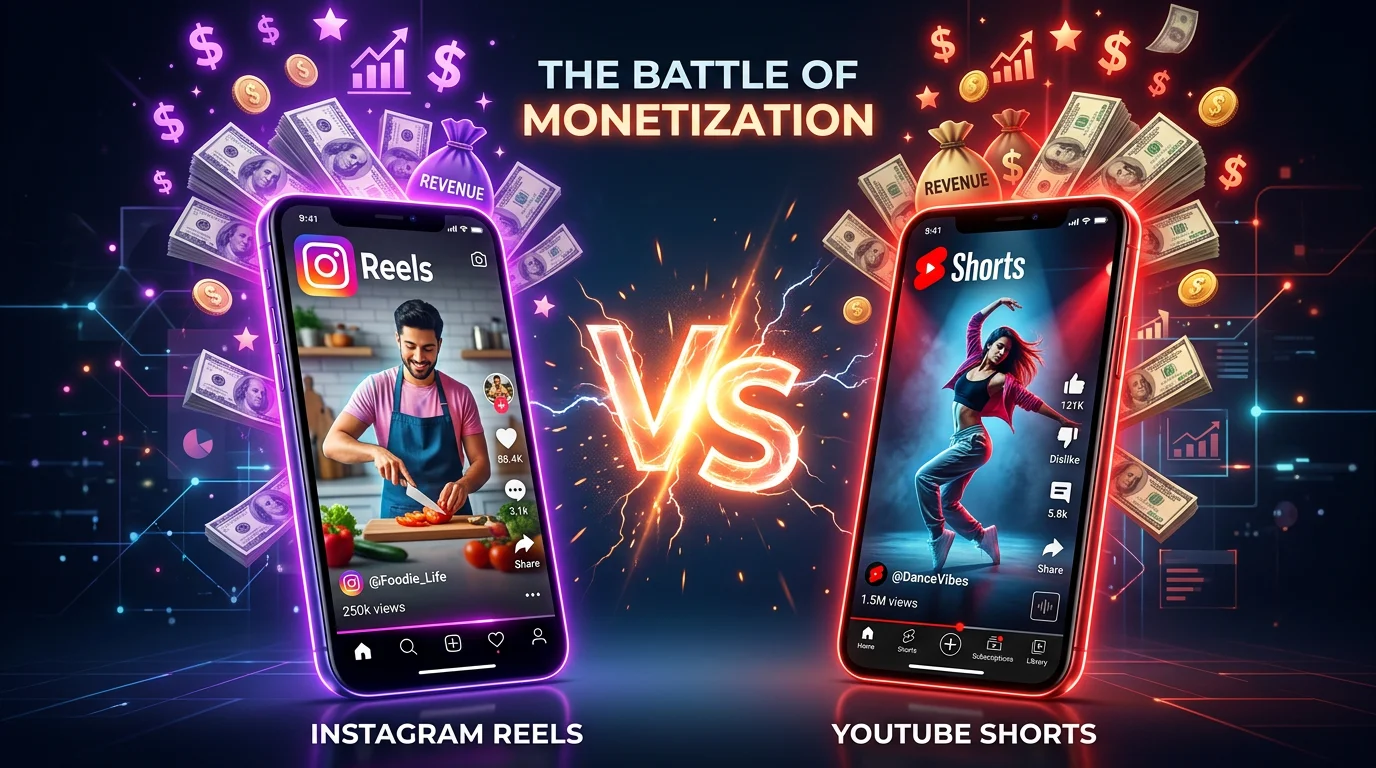
Most faceless creators pick one platform — either faceless Reels or YouTube Shorts — and ignore the other completely. That decision is quietly costing them thousands of dollars a year.
Here''s the thing: both formats are identical. Vertical video. 9:16 aspect ratio. Under 60 seconds. The same video that performs on YouTube Shorts can perform on Instagram Reels with zero extra production work. So why would you limit yourself to one audience when you could reach two?
This guide is an honest, data-backed comparison of faceless Reels vs YouTube Shorts in 2026 — covering monetization, algorithm behavior, audience differences, and growth potential. If you''re already making faceless Reels or faceless Shorts, this will help you figure out where the money actually is — and why the smartest creators post to both.
The Quick Answer
| Factor | YouTube Shorts | Instagram Reels |
|---|---|---|
| Direct Ad Revenue | Winner — 45% revenue share | No consistent revenue share |
| Brand Deals | Possible but less common | Winner — higher deal volume |
| Affiliate Income | Good (description links) | Winner (link-in-bio funnels) |
| Community Building | Decent | Winner — DMs, Stories, Close Friends |
| Best Strategy | Post to both — the content is identical | |
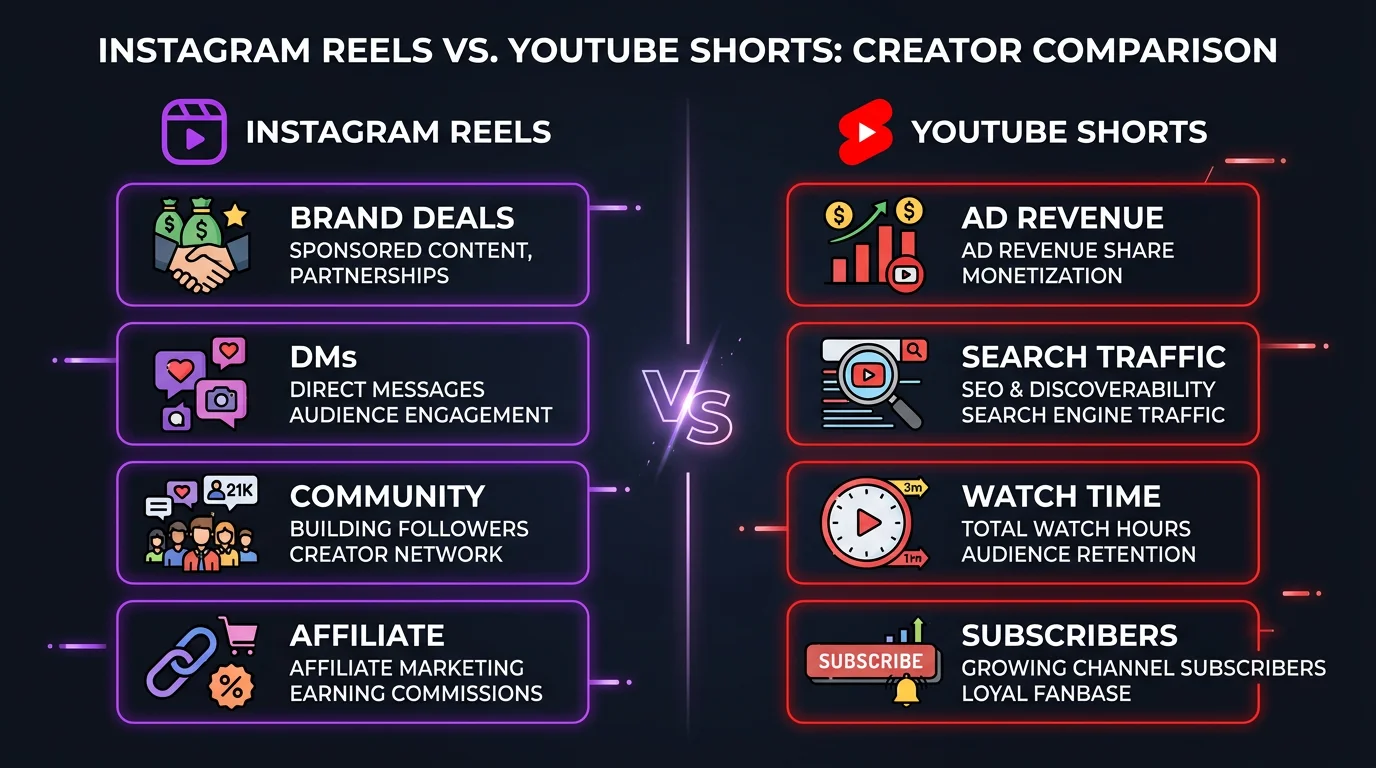
YouTube Shorts wins on passive ad revenue. Instagram Reels wins on brand deals, affiliate marketing, and community monetization. For faceless creators, the smart play is posting the same video to both platforms — because the content format is exactly the same.
Monetization Comparison — Where the Money Comes From
Let''s break down how money actually flows on each platform. The models are fundamentally different, and understanding that difference is the key to maximizing your income as a faceless creator.
YouTube Shorts Monetization
YouTube offers a direct revenue share model for Shorts through the YouTube Partner Program. Creators in the YouTube Partner Program earn 45% of the ad revenue allocated to their Shorts content. This is passive income — ads run between Shorts in the feed, and you get paid based on views.
The typical RPM (revenue per thousand views) for Shorts sits between $0.01 and $0.07, depending on your niche, audience location, and time of year. Finance and tech niches tend to land at the higher end. Entertainment and memes sit at the lower end.
To qualify, you need to meet the YouTube Shorts monetization requirements: either 1,000 subscribers + 10 million Shorts views in 90 days, or 1,000 subscribers + 4,000 watch hours from long-form content. For a detailed breakdown of the math behind this, see our guide on how to monetize YouTube Shorts.
The biggest advantage here: it''s completely passive. You don''t need to pitch brands, negotiate deals, or build a link-in-bio funnel. You post videos, people watch, you get paid. For faceless creators who want to stay anonymous, that''s a huge benefit.
Instagram Reels Monetization
According to Instagram's creator resources, the platform does not offer a reliable, built-in revenue share program for Reels. The bonuses that existed in previous years were invitation-only, inconsistent, and have been reduced or discontinued for most creators.
So where does the money come from? For faceless Reels creators, there are four main paths:
- Brand deals and sponsorships — Brands pay you to feature their product in a Reel. Faceless accounts in niches like finance, luxury, and motivation can command $100 to $5,000+ per post depending on follower count and engagement rate.
- Affiliate marketing — You promote products via your link-in-bio and earn commission on every sale. Instagram''s visual format and DM culture make this particularly effective.
- Digital product sales — Selling ebooks, templates, courses, or presets. Instagram''s community features (DMs, Stories, Close Friends) are strong for nurturing an audience into buyers.
- Account flipping — Growing a faceless account to 50K-100K+ followers and selling it. This is more common than people realize in the faceless space.
For a deeper dive into these methods, check out our Instagram monetization guide.
The key difference: Instagram monetization requires more active work. You need to build relationships, set up funnels, and do outreach. But the ceiling per post is often higher than YouTube''s ad revenue, especially for brand deals.
Earnings Comparison Table
| Revenue Source | YouTube Shorts | Instagram Reels |
|---|---|---|
| Ad Revenue Share | $0.01-$0.07 per 1K views (45% share) | No consistent program |
| Brand Deals (per post) | $50-$1,000 | $100-$5,000+ |
| Affiliate Income | Moderate (description links) | High (link-in-bio + DMs) |
| Digital Products | Low (weak community tools) | High (Stories, DMs, Close Friends) |
| Account Flipping | Rare | Common ($500-$10,000+) |
| Monthly Earnings (100K views/mo) | $1,000-$7,000 (ads only) | $0 (ads) to $5,000+ (deals/affiliate) |
| Effort Level | Passive — just post | Active — outreach and funnels needed |
| Monetization Threshold | 1K subs + 10M Shorts views | None (but need followers for deals) |
Create Faceless Videos on Autopilot
FlowShorts generates and posts AI videos to YouTube, TikTok & Instagram while you sleep.
Try FlowShorts Free →Algorithm Differences for Faceless Content
The algorithms on YouTube and Instagram are optimized for different behaviors. Understanding these differences helps you tailor your content — even when posting the same video to both platforms.
YouTube Shorts algorithm priorities:
- Watch time and completion rate — How much of the Short do viewers watch? Loops count.
- Click-through rate — The thumbnail and title matter, even for Shorts.
- Subscriber conversion — Does the Short convince viewers to subscribe?
- Search discoverability — Shorts appear in YouTube search results. A Short about "how to start investing" can get views for years via search traffic.
YouTube pushes Shorts to non-subscribers via the Shorts shelf, and content remains discoverable indefinitely through search. This is the single biggest advantage YouTube has for faceless creators: your content has a long tail. A video posted six months ago can still drive views and revenue today.
Instagram Reels algorithm priorities:
- Saves and shares — The highest-weighted engagement signals in 2026. DM shares are especially powerful.
- Completion rate — Does the viewer watch the full Reel?
- Comments and replies — Especially when the creator responds.
- Explore and Reels tab distribution — Instagram pushes Reels to non-followers via these surfaces.
The critical difference: Instagram Reels have a much shorter lifespan. A Reel typically peaks within 48 hours and then distribution drops off sharply. There''s no search index like YouTube has. Your content lives and dies by the algorithm''s initial push.
For faceless content specifically: YouTube is better for evergreen educational content — tutorials, explainers, "did you know" facts, and how-to content that people search for. Instagram is better for emotional and shareable content — motivational clips, aesthetic compilations, relatable psychology facts, and visually striking luxury content.
Audience and Growth Comparison
The audiences on these platforms are different — and that matters for both monetization and content strategy.
| Factor | YouTube Shorts | Instagram Reels |
|---|---|---|
| Primary Demographics | 18-49, slightly more male, global | 18-34, slightly more female, US/EU heavy |
| Growth Speed | Slower but steadier | Faster viral spikes, less predictable |
| Engagement Type | Views, subscribers, comments | Saves, shares, DMs, Story replies |
| Content Lifespan | Months to years (search indexing) | 24-72 hours (algorithm-driven) |
| Discoverability | Search + Shorts shelf + suggested | Explore tab + Reels tab only |
| Subscriber/Follower Value | High — feeds into long-form content | High — feeds into Stories, DMs, bio link |
| Cross-Format Opportunity | Shorts → long-form videos → higher RPM | Reels → Stories → DMs → sales |
The growth pattern is different too. YouTube tends to deliver consistent, compounding growth — your subscriber count grows steadily and your older content keeps working for you. Instagram delivers more volatile, spike-driven growth — one viral Reel can add 10K followers overnight, but the next week might be flat.
For faceless creators, YouTube''s compounding model is more forgiving. You don''t need every video to go viral. You need a library of decent content that accumulates views over time. Instagram rewards consistency too, but it''s more of a "what have you posted lately?" platform.
Which Platform Is Better for Each Faceless Niche?
Not every niche performs equally on both platforms. Here''s a breakdown based on what we''ve seen from faceless creators across different categories. For help finding your ideal niche, try our free niche finder tool.
| Niche | Better Platform | Why |
|---|---|---|
| Motivation | High save rate and share rate — Reels get sent via DMs constantly | |
| Finance | YouTube | Higher CPM ($0.05-$0.07), strong search traffic for financial topics |
| Horror / True Crime | YouTube | Longer watch time, evergreen content, loyal subscriber base |
| Psychology / Facts | Tie | Educational content works on YouTube search; "save-worthy" content works on Instagram |
| Science / Space | YouTube | Search-driven discovery, evergreen explainers, higher CPM |
| Luxury / Lifestyle | Visual-first platform, brand deal volume is much higher | |
| Tech / AI | YouTube | Tech audience lives on YouTube, strong search traffic, high CPM |
| Stoicism / Quotes | Quote content gets saved and shared heavily — Instagram''s strongest signals |
But here''s the important nuance: even if one platform is "better" for your niche, the other platform still works. A faceless finance account will earn more per view on YouTube — but it can still build a meaningful audience on Instagram and monetize through affiliate links and digital products. Explore the full best niches for faceless Reels breakdown for more detail.
Why Posting to Both Is the Real Answer
This is the section that matters most. The debate between faceless Reels vs YouTube Shorts is a false choice — because posting to both costs you almost nothing extra.
Create Faceless Videos on Autopilot
FlowShorts generates and posts AI videos to YouTube, TikTok & Instagram while you sleep.
Try FlowShorts Free →Think about what''s actually involved in creating a faceless short-form video:
- Write a script
- Generate or source visuals
- Add voiceover
- Add captions and music
- Export a 9:16 vertical video
That video — the exact same file — can be uploaded to YouTube Shorts, Instagram Reels, and TikTok. There is no extra production work. The format is identical across all three platforms.
Here''s why this matters financially:
- Different audiences — The people watching Shorts and the people watching Reels overlap less than you''d think. Posting to both gives you roughly 2x the reach from the same content.
- Different monetization models — YouTube gives you passive ad revenue. Instagram gives you brand deal and affiliate opportunities. Running both means you''re earning from multiple income streams.
- Different content lifespans — YouTube provides long-term search traffic that compounds over months. Instagram provides short-term viral spikes that drive immediate engagement. Together, you get both.
- Platform insurance — Algorithm changes happen. If one platform tanks your reach, the other keeps working. Diversification protects your income.
Tools like FlowShorts make this even easier by generating faceless videos and auto-posting them to YouTube Shorts, Instagram Reels, and TikTok from a single dashboard — so you don''t even need to manually upload to each platform.
The creators earning the most in 2026 aren''t choosing between platforms. They''re posting the same content everywhere and letting each platform''s monetization model do its thing. For a broader comparison that includes TikTok in the mix, see our YouTube Shorts vs TikTok vs Reels breakdown.
Frequently Asked Questions
Does Instagram Reels or YouTube Shorts pay more per view?
YouTube Shorts pays more per view directly, with RPMs between $0.01 and $0.07 per thousand views through the YouTube Partner Program''s revenue share. Instagram Reels doesn''t have a consistent per-view payment model. However, Instagram creators often earn more per post through brand deals and affiliate marketing, especially once they''ve built an engaged following. The per-view comparison favors YouTube, but total earnings depend on your monetization strategy.
Can I post the same faceless video to both platforms?
Yes — and you should. The video format is identical: 9:16 vertical, under 60 seconds. The same video file works on both YouTube Shorts and Instagram Reels. Neither platform penalizes cross-posted content. The only thing to watch is removing any platform-specific watermarks (like the TikTok logo) before uploading elsewhere, as that can reduce distribution.
Which platform is easier to grow on for faceless creators?
Instagram Reels tends to deliver faster initial growth — faceless accounts in niches like motivation and luxury can hit 10K followers in weeks with consistent posting. YouTube Shorts grows more slowly but more predictably, and your content stays discoverable for months through search. If you want quick follower growth, start with Instagram. If you want sustainable, compounding reach, YouTube is stronger. Ideally, you build on both simultaneously.
How much do faceless creators earn per month?
Earnings vary enormously based on niche, view count, and monetization method. A faceless creator getting 500K views per month across both platforms might earn $500-$3,500 from YouTube ad revenue alone, plus $500-$5,000+ from Instagram brand deals and affiliate income. Top faceless creators in high-CPM niches like finance and tech report $5,000-$15,000+ per month. The key is diversifying across platforms and monetization methods — not relying on a single income stream. Learn more about the YouTube side in our faceless YouTube videos guide.
The Bottom Line: Post to Both
The faceless Reels vs YouTube Shorts debate has a simple answer: don''t choose. YouTube Shorts gives you passive ad revenue and long-term search discoverability. Instagram Reels gives you brand deal opportunities, affiliate income, and community-driven monetization. The content format is identical, so posting to both costs you almost no extra time or effort.
The smartest faceless creators in 2026 aren''t platform-loyal. They''re platform-diversified. One video, multiple uploads, multiple income streams.
If you''re ready to start building a faceless content machine that posts to every platform automatically, try FlowShorts — it generates and auto-posts faceless videos to YouTube Shorts, Instagram Reels, and TikTok on autopilot. Or if you''re just getting started with faceless content, begin with our complete guide on how to make faceless Reels.
Free Tools for Faceless Creators
- Faceless Niche Finder — Discover profitable niches for faceless content
- Video Script Generator — Generate short-form video scripts in seconds
- Faceless Reels Generator — Create faceless Instagram Reels with AI
Related Guides
- How to Make Faceless Reels (Complete Guide)
- How to Monetize YouTube Shorts
- How to Monetize Instagram
- YouTube Shorts vs TikTok vs Reels
The Complete Faceless Reels Guide Series
- How to Make Faceless Reels with AI (Pillar Guide)
- 30 Faceless Reels Ideas That Get Views
- Best Niches for Faceless Reels (with CPM Data)
- Faceless Reels vs YouTube Shorts: Which Pays More?
- How to Monetize Faceless Reels
- Best AI Tools for Faceless Reels
- Faceless Reels Script Templates
- Faceless Reels Posting Schedule