How to Write a Script for YouTube Video That Gets Views
Learn how to craft a script for youtube video that hooks viewers with actionable tips, templates, and formats for Shorts and faceless content.
FlowShorts Team
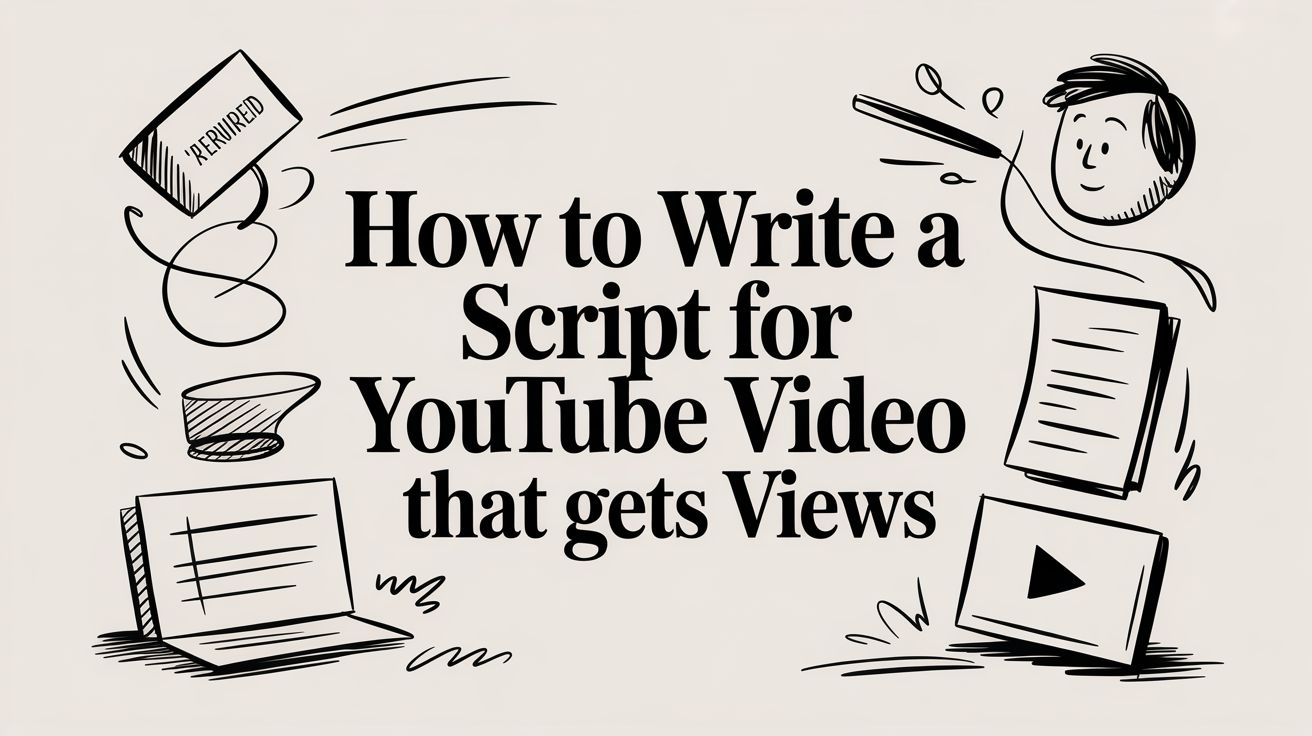
A YouTube script is the structure behind your video: the hook, the core content, and the call-to-action. Writing it out before recording (or before feeding it to an AI tool) forces you to cut filler, tighten your pacing, and front-load the most interesting material.
This guide covers script structure, hook formulas, storytelling frameworks, CTAs, and word-count targets for both long-form and Shorts.
Why Scripts Matter More Than Production Quality
YouTube's algorithm ranks videos by retention, not production value. A well-scripted video shot on a phone outperforms a beautifully filmed video where the creator rambles for the first 30 seconds.
What a script actually fixes:
- Watch time: Cutting filler and front-loading value keeps people watching longer. YouTube uses this as the primary signal for recommending videos.
- Retention curve: A planned beginning, middle, and end prevents the mid-video drop-off that kills reach.
- Subscriber conversion: When videos consistently deliver, viewers subscribe. Scripting is what makes "consistently" possible.
This applies to every format: long-form, Shorts, faceless content, talking-head. If you're speaking (or a voiceover is), a script improves the output.
The Three Parts of Every YouTube Script
Every effective video script has three sections. The names vary, but the function doesn't.
| Section | Purpose | Target |
|---|---|---|
| Hook | Stop the scroll | First 3 seconds: create curiosity or state a bold promise |
| Core content | Deliver on the promise | Tips, story, tutorial, or information in a clear, structured flow |
| CTA | Convert viewer to subscriber | Specific, relevant next step (not generic "like and subscribe") |
The rest of this guide breaks down each section with formulas and examples.
Hook Formulas That Work
You have about 3 seconds before a viewer decides to stay or scroll. The hook's job is to create an information gap or promise a payoff worth waiting for.
For faceless channels, the hook is usually a bold text overlay paired with the opening voiceover line. Here are three formulas with niche-specific examples:
1. The Controversial Statement
Challenge a common belief. This creates instant tension and makes viewers think, "Wait, am I wrong about this?"
- Science: "Sleep isn't for resting your body. It's for cleaning your brain."
- Finance: "Your 401(k) might be the slowest way to build real wealth."
- History: "The pyramids weren't built by slaves."
2. The Intriguing Question
Direct questions flip the viewer's brain from passive scrolling to active thinking.
Create Faceless Videos on Autopilot
FlowShorts generates and posts AI videos to YouTube, TikTok & Instagram while you sleep.
Try FlowShorts Free →- Luxury: "What makes a $10,000 watch ten times better than a $1,000 one?"
- Science: "Could humans survive on Mars with today's technology?"
- Motivation: "What if procrastination is your brain trying to protect you?"
3. In Medias Res (Start in the Middle)
Drop the viewer into the most dramatic moment of the story. They have to keep watching to understand the context.
- History: "This Roman Emperor was so hated, they erased his face from every statue and coin in the empire."
- Finance: "In 2008, one man made $4 billion by betting against the entire housing market."
The hook is a promise. The rest of the video is you keeping it.
Structuring the Core Content
The middle of your script is where most creators lose viewers. The fix: pick a storytelling framework before you write, and stick to it.
Four Frameworks for Different Content Types
| Framework | Best For | Example |
|---|---|---|
| Problem-Agitation-Solution (PAS) | Finance, self-improvement, tutorials | "Hate feeling unproductive? You're wasting hours on tasks that don't matter. Here's the one technique that fixes it." |
| Before-After-Bridge (BAB) | Fitness, business case studies, DIY | "I was broke and paycheck-to-paycheck. Now I run a 6-figure business. Here's the bridge." |
| Hero's Journey | History, motivation, documentaries | "He was a regular guy from a small town, until one discovery changed everything..." |
| Listicle (Top 3/5/7) | Tech, travel, lifestyle, almost anything | "Here are the top 5 mistakes new investors make, starting with number 5..." |
PAS is the most versatile. It works for almost any educational or problem-solving content because it builds tension (the problem), amplifies it (the agitation), and resolves it (the solution). Viewers stay because they're invested in the resolution.
Writing for the Ear, Not the Page
Video scripts are spoken, not read. A sentence that looks clean on screen can sound clunky out loud. Three rules:
- Keep sentences short. If you run out of breath reading it aloud, it's too long.
- Use conversational language. Write "use" not "utilize." Write "help" not "facilitate."
- Read your script aloud before recording. If you stumble on a phrase, rewrite it.
Visual Cues for Faceless Content
If there's no face on camera, your script needs to direct the visuals too. Embed visual cues directly in the script so the editor (or AI tool) knows exactly what to show.
Example cues:
[Visual: Quick cuts of luxury watches ticking][Text Overlay: "The 3 Secrets of the Super Rich"][Visual: Animated graph showing stock market growth]
This turns your script from a voiceover transcript into a full production blueprint.
Writing a CTA That Converts
Create Faceless Videos on Autopilot
FlowShorts generates and posts AI videos to YouTube, TikTok & Instagram while you sleep.
Try FlowShorts Free →"Like and subscribe" is background noise at this point. Most viewers tune it out. A CTA that works feels like the natural next step after the value you just delivered.

Three CTA approaches that drive real engagement:
- The engagement question: Tie a question to the video's topic. After a history video: "Comment which historical mystery you want me to cover next." This sparks conversation and signals engagement to the algorithm.
- Subscribe with a reason: Give them a concrete reason. "Subscribe for a new science breakdown every day" works. "Please subscribe" doesn't.
- The closing loop: Tease your next video to create a mini-cliffhanger. "Now you know the secrets behind this watch. But next video, we're exposing the one brand that's even more exclusive. Subscribe so you don't miss it."
The closing loop is particularly effective because it turns "subscribe" from a request into a logical decision.
Script Length Guide
How long should your script be? It depends on the format and your speaking pace (most people average 140-160 words per minute).
| Format | Duration | Script Length |
|---|---|---|
| YouTube Short | 30 seconds | 70-80 words |
| YouTube Short | 60 seconds | 150-160 words |
| Long-form | 8-10 minutes | 1,200-1,500 words |
| Long-form | 15-20 minutes | 2,200-3,000 words |
For Shorts, every word counts. If a sentence doesn't strengthen the hook, add value, or push toward the CTA, cut it.
Tools for Writing YouTube Scripts
You don't need specialized software. The best tool is whichever one you'll actually use consistently.
- Google Docs: Free, cloud-based, easy to share with editors. Use comments to note visual cues or tone reminders.
- Notion: Good for organized creators who want templates, a content calendar, and scripts in one workspace.
- AI script generators: Tools like FlowShorts generate structured first drafts for specific niches, which you can then edit. Useful for maintaining daily output without writing every script from scratch. For a broader look at AI video tools, see our guide on the best AI video generators.
Common Questions
How Do I Find My Writing Voice?
Write how you talk, then clean it up. After drafting, read the script aloud. If a phrase feels unnatural to say, rewrite it. Your voice is whatever makes you sound like a person and not a textbook. Humor, opinions, and a specific way of explaining things all contribute.
Should I Script Every Word or Use Bullet Points?
For Shorts and faceless content: script every word. There's no room for improvisation in 60 seconds, and the voiceover needs exact text. For long-form talking-head videos: a detailed outline with key phrases works if you're comfortable on camera. But if you tend to ramble, a full script will tighten your delivery.
How Do I Write Scripts Faster?
Use templates. Once you find a framework that works for your niche (PAS, listicle, etc.), create a reusable template with placeholder sections. The structure stays the same; only the topic changes. This cuts writing time significantly after the first few scripts.
Related Guides
- How to Make Videos Go Viral
- How to Make AI YouTube Shorts
- 50 Faceless YouTube Channel Ideas
- How to Post on YouTube From Start to Finish
Related: Word Count to Speaking Time Guide
Related: Words Per Minute Speaking: Average Speeds Guide
Free tools: AI Video Script Generator · YouTube Title Generator