Is a Faceless YouTube Channel Worth It in 2026? (Honest Answer)
Is a faceless YouTube channel worth it? Here's an honest look at the real earnings potential, time investment, and what it takes to succeed in 2026.
FlowShorts Team
Is a faceless YouTube channel worth it? The short answer: yes — but only if you go in with realistic expectations and a real strategy. A faceless channel is not a passive income button you press and walk away from. It is a media business that rewards consistency, niche selection, and smart use of tools. Get those three things right and it is absolutely worth it. Get them wrong and you will spend months creating videos nobody watches.
This guide gives you the honest breakdown — real earnings data, actual time requirements, who should start one, and who should not. No hype, no "I made $10,000 in my first month" fabrications. Just the data you need to make a smart decision in 2026.
Key Takeaways
- Yes, it is worth it — but with realistic expectations. Most channels take 6–12 months to reach YouTube Partner Program eligibility (1,000 subscribers + 4,000 watch hours).
- Earnings vary dramatically by niche. Finance channels can earn $15–$25 RPM. Motivation channels earn $3–$8 RPM. Niche selection is the single biggest lever on your income.
- Consistency beats quality in the early stage. Channels that post 3–5 times per week grow 2–3x faster than channels posting once a week, regardless of production quality.
- AI tools have changed the math. What used to take 8–10 hours per video can now be produced in under an hour with the right AI stack, making faceless channels more viable than ever in 2026.
What Is a Faceless YouTube Channel?
A faceless YouTube channel is a channel where the creator never appears on camera. Content is delivered through AI voiceovers, stock footage, screen recordings, animations, or text overlays. The creator's identity is separate from the brand — meaning the channel can be operated by a team, scaled across multiple niches, or sold as a standalone digital asset without being tied to any single person's face or reputation.
Real Earnings Data for Faceless Channels
Before you commit to a faceless channel, you need to understand the actual revenue mechanics. YouTube pays creators through its Partner Program based on RPM (Revenue Per Mille) — the amount earned per 1,000 views after YouTube takes its 45% cut.
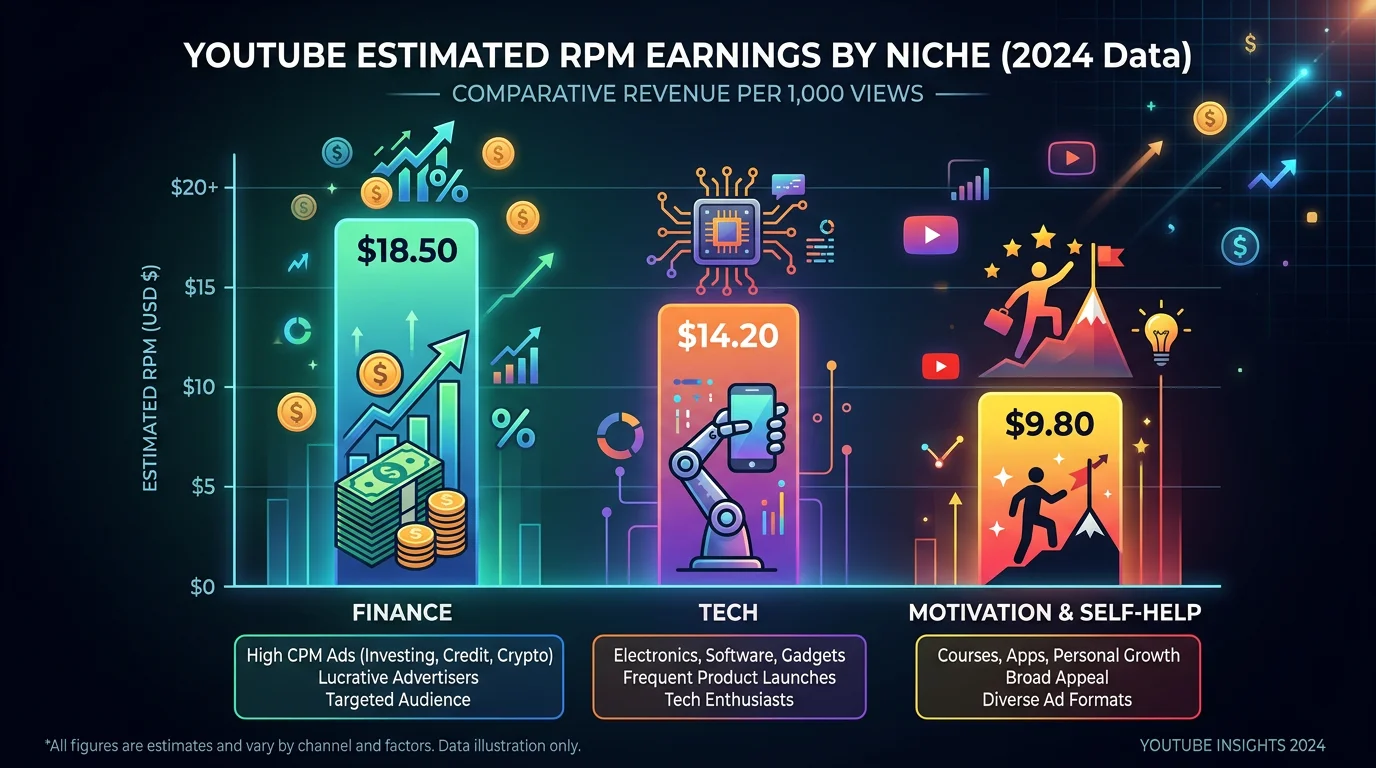
RPM varies enormously by niche because advertisers pay different rates depending on the audience's purchasing power and intent:
- Finance & investing: $15–$25 RPM. The highest-paying niche on YouTube. Advertisers (banks, brokerages, insurance companies) pay premium rates to reach viewers who have money to spend.
- Technology & software: $8–$15 RPM. Strong advertiser demand from SaaS companies, hardware brands, and tech services targeting professional audiences.
- Business & entrepreneurship: $10–$18 RPM. High-intent audience attracts course creators, B2B software, and consulting advertisers.
- Motivation & self-improvement: $3–$8 RPM. Popular niche with massive view counts, but lower advertiser demand keeps RPM modest.
- Entertainment & general facts: $2–$5 RPM. High volume, low per-view revenue. Requires millions of views to generate meaningful income.
What Do These Numbers Mean in Practice?
Let's translate RPM into real monthly income at different audience sizes:
| Monthly Views | Finance ($20 RPM) | Tech ($12 RPM) | Motivation ($5 RPM) |
|---|---|---|---|
| 100,000 | $2,000/mo | $1,200/mo | $500/mo |
| 500,000 | $10,000/mo | $6,000/mo | $2,500/mo |
| 1,000,000 | $20,000/mo | $12,000/mo | $5,000/mo |
A channel with 100,000 subscribers typically generates between 300,000 and 600,000 views per month, depending on how frequently it uploads and its click-through rate. At those numbers, a finance channel can realistically earn $6,000–$12,000 per month from AdSense alone — before any sponsorships, affiliate deals, or digital products.
For a deeper look at income breakdowns by channel size, see our guide on faceless YouTube channel income: what creators actually earn.
Pros of a Faceless YouTube Channel
1. Complete Privacy and Anonymity
You never have to appear on camera, manage your personal brand, or worry about how you look or sound. Your personal life stays separate from your business. This matters for people who want to build income without public exposure — or who simply prefer to keep their professional identity private. It also means you can create content in any niche without it being attached to your name permanently.
2. Scalable With AI Tools
In 2025 and 2026, the production cost and time for faceless content has dropped dramatically. AI scriptwriters, voice generators, image creators, and auto-posting tools mean one person can manage content output that previously required a full production team. Tools like FlowShorts can generate and auto-post faceless short-form videos to YouTube Shorts, TikTok, and Instagram Reels on a fully automated schedule — eliminating the bottleneck that kills most solo creators.
3. Run Multiple Channels Across Different Niches
Because no personal brand is attached to the channel, you can operate in multiple niches simultaneously. A creator with an on-camera cooking channel cannot credibly also run a finance channel. A faceless creator can. This lets you diversify income across niches, hedge against algorithm changes in any single niche, and scale into new markets without starting over.
4. Genuine Passive Income Potential
Once a faceless channel is monetized and has a library of evergreen content, AdSense income can continue for months or years with minimal ongoing effort. A well-optimized video about compound interest or investing basics can generate views — and income — for years after it's published. This is the closest thing to real passive income that YouTube offers.
Create Faceless Videos on Autopilot
FlowShorts generates and posts AI videos to YouTube, TikTok & Instagram while you sleep.
Try FlowShorts Free →5. Global Audience, No Geographic Limit
Faceless channels are not tied to any location. You can create content from anywhere, target any language market, and reach viewers worldwide. Channels that target English-language audiences access the highest-RPM advertising market. But faceless formats also translate well — some creators run the same channel concept in multiple languages with AI dubbing, multiplying their reach without multiplying their workload.
Cons of a Faceless YouTube Channel
1. Slower Initial Growth Compared to Personal Brands
On-camera creators with strong personalities can build loyal audiences faster because viewers connect with people, not brands. Faceless channels tend to grow more slowly in the early months because they rely entirely on content quality and SEO to drive discovery. Expect 3–6 months before you see meaningful traction on a new faceless channel, even with consistent uploads.
2. Requires Consistent, High-Volume Uploads
The YouTube algorithm rewards consistency. Faceless channels that post 3–5 times per week consistently outperform channels that post 1–2 high-effort videos. This means you need systems — content calendars, AI tools, batch production — to maintain that pace without burning out. Without systems, most creators quit before the channel gains momentum.
3. Monetization Takes Time and a High Threshold
YouTube's Partner Program requires 1,000 subscribers and 4,000 watch hours before you can run ads. For a new faceless channel, reaching those thresholds typically takes 6–12 months of consistent uploading. During that period, you generate no AdSense income. You need to either have patience, fund the operation from other income, or monetize through affiliate links and sponsorships before the channel qualifies for YPP.
4. High Competition in Popular Niches
The most profitable faceless niches — finance, motivation, tech facts — are also the most crowded. Thousands of channels compete for the same keywords and viewer attention. Without genuine differentiation in angle, format, or content depth, new channels struggle to stand out. The channels winning in competitive niches are not just posting more — they are finding underserved sub-topics within large niches.
5. Content Quality Still Matters
"Faceless" does not mean "low effort." YouTube's algorithm measures watch time, click-through rate, and audience retention. A poorly scripted video with a generic AI voice and stock footage that viewers skip after 15 seconds will not rank. The production barrier has dropped significantly, but the content quality bar has risen to match. The best faceless channels invest in compelling scripts, high-retention hooks, and structured storytelling even without a face on camera.
Faceless Channel vs Face-on-Camera: Which Grows Faster?
The honest answer depends on what you are measuring and what stage of growth you are in. Here is how the two formats compare across the factors that matter most:
| Factor | Faceless Channel | Face-on-Camera Channel |
|---|---|---|
| Early growth speed | Slower (relies on SEO + algorithm) | Faster (personality drives shares and loyalty) |
| Long-term scalability | High (team-operable, AI-assistable) | Limited (tied to one person's time) |
| Production time per video | 1–3 hours (with AI tools) | 3–8 hours (filming, reshoots, editing) |
| Production cost | Low ($0–$100/mo with AI tools) | Medium–High ($200–$2,000+ for camera, lighting, editing) |
| Sponsorship potential | Medium (brand deals possible at scale) | High (personal connection commands premium rates) |
| Sellability as a business | High (24–36x monthly revenue) | Very low (tied to creator's identity) |
| Privacy | Complete | None |
| Burnout risk | Lower (no on-camera pressure) | Higher (constant on-camera presence required) |
| Ideal for | Introverts, side hustlers, agencies | Charismatic personalities, lifestyle creators |
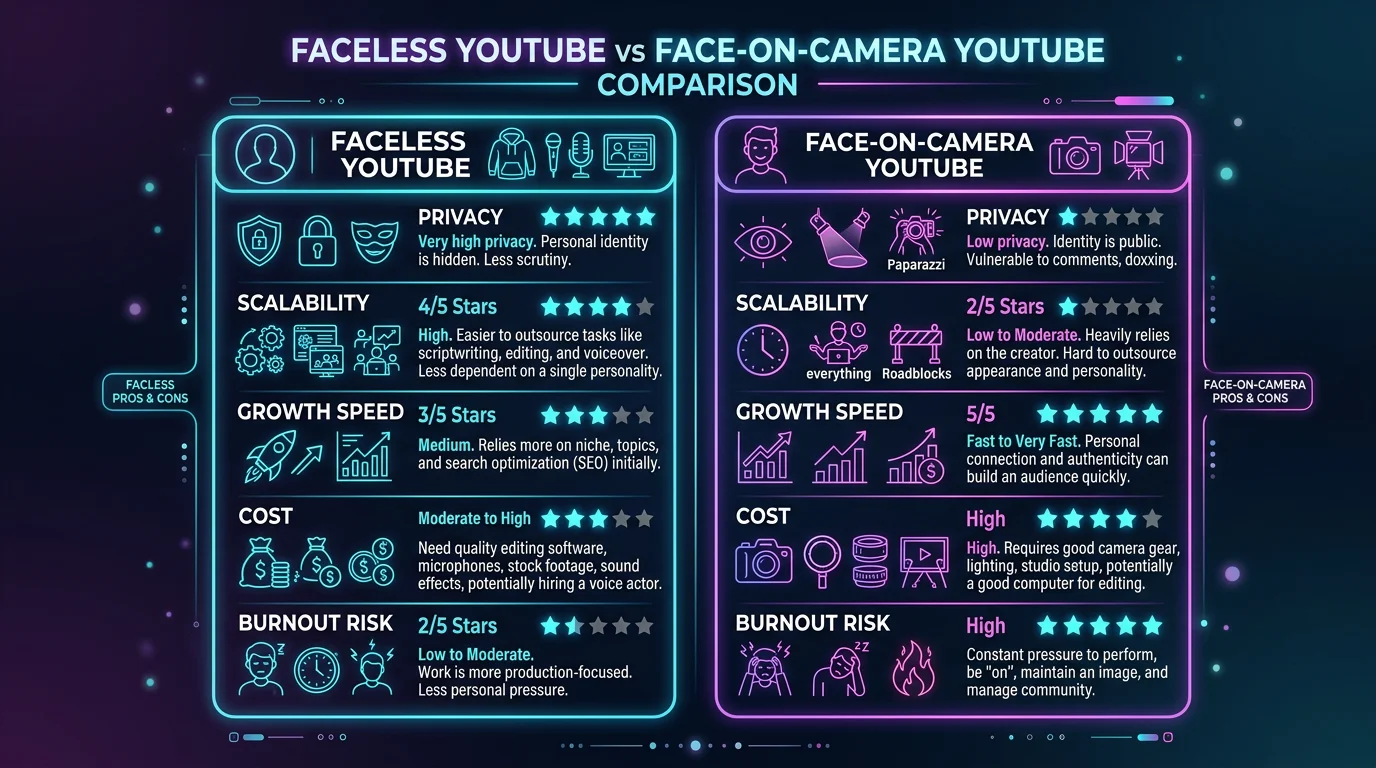
Face-on-camera channels tend to grow faster in the 0–10,000 subscriber range because personality drives word-of-mouth sharing. Faceless channels often overtake them in the 10,000–100,000+ range because they can maintain higher upload frequency and operate at scale. For creators who want a business — not a personal brand — faceless wins on nearly every metric that matters past the initial launch phase.
Who Should Start a Faceless YouTube Channel?
Introverts and Privacy-Conscious Creators
If the idea of being on camera feels like a barrier you will never fully overcome, a faceless channel removes that barrier entirely. This is not a compromise — many of the most successful YouTube channels ever built are faceless. BRIGHT SIDE (44.7M subscribers), Kurzgesagt (24M subscribers), and The Infographics Show (14M subscribers) have built media empires without a single recognizable face. If you have ideas, research skills, and the ability to write a compelling script, you have everything you need.
People With a Day Job Who Want a Side Income
Faceless channels fit around a full-time schedule better than any other YouTube format. You can batch-produce content on weekends, use AI tools to handle voiceover and editing during the week, and schedule posts in advance. With a tool like FlowShorts, you can set your niche and posting schedule once and have videos automatically generated and posted to YouTube Shorts, TikTok, and Instagram Reels without touching the process daily. This is the format designed for people with limited time but long-term ambition.
Agencies and Entrepreneurs Building Content Portfolios
Create Faceless Videos on Autopilot
FlowShorts generates and posts AI videos to YouTube, TikTok & Instagram while you sleep.
Try FlowShorts Free →Faceless channels are ideal for content agencies, marketing firms, and entrepreneurs who want to own digital assets that generate revenue independently of their personal time. Because the channel is not tied to a face, it can be operated by a team, maintained across ownership changes, or built as an asset for eventual sale. Channels in the finance, tech, and business niches routinely sell on marketplaces like Flippa for 24–36 times monthly revenue, making them attractive investment vehicles for operators who understand content businesses.
Who Should NOT Start a Faceless YouTube Channel?
People Expecting Fast Viral Fame
If your goal is to become famous — to build a following that knows your face, follows your personal story, and treats you like a celebrity — a faceless channel is the wrong vehicle. Faceless channels build audiences around topics, not personalities. Viewers subscribe because they want more content about finance, tech, or history — not because they are fans of the creator specifically. If personal recognition is the goal, go on-camera. If income and audience reach are the goal, faceless works. Know which one you actually want before you start.
People Without a Content Strategy
Posting random videos with no niche focus, no keyword research, and no understanding of what your target audience is searching for is a reliable path to failure — on any YouTube channel, but especially a faceless one. Faceless channels do not have personality to carry weak content. Every video needs to target a real search term, deliver genuine value, and be structured for retention. Creators who treat a faceless channel as a "set it and forget it" operation without building a content strategy first almost universally quit within 90 days with nothing to show for it.
How to Make a Faceless Channel Worth It in 2026
Step 1: Pick the Right Niche
Niche selection determines everything — your RPM, your competition level, your content volume, and your monetization ceiling. The best niches for faceless channels combine three qualities: high advertiser demand (RPM above $8), evergreen content potential (topics that stay relevant for years), and enough sub-topics to sustain hundreds of videos. Finance, technology, business, and history all meet these criteria. For a full breakdown of which niches perform best, see our guide on the top faceless YouTube niches in 2026.
Step 2: Post Consistently Using AI Tools
Consistency is the single biggest predictor of faceless channel growth, and AI tools have made it achievable for solo creators. The old production workflow — write script, record voiceover, source footage, edit, add captions, export, upload — took 6–10 hours per video. With the right AI stack, that entire process can be completed in under an hour.
FlowShorts is built specifically for this workflow. It generates faceless short-form videos from scratch — script, AI voiceover, visuals, and captions — and auto-posts them to YouTube Shorts, TikTok, and Instagram Reels on a schedule you set. The Starter plan at $19/month gives you 8 videos per month. The Creator plan at $39/month gives you 30 videos per month — enough to post daily across all three platforms. The Pro plan at $69/month delivers 60 videos per month for creators scaling aggressively.
Step 3: Optimize for Shorts in the Early Stage
New channels struggle to get long-form video views because the algorithm has no data on their quality or audience. YouTube Shorts changes this equation. Shorts are shown to non-subscribers through the Shorts feed, giving new channels access to a discovery surface that does not require an existing audience. Channels that use Shorts strategically in their first 6 months grow 2–3x faster than channels that post only long-form content. For a complete walkthrough of this strategy, see our guide on how to make faceless YouTube videos that actually grow.
Frequently Asked Questions
Is a faceless YouTube channel worth it?
Yes, a faceless YouTube channel is worth it for creators who approach it as a real business — with consistent uploads, a clear niche, and smart use of AI tools. Channels in high-RPM niches like finance and technology can realistically earn $2,000–$10,000 per month once they reach 100,000–500,000 monthly views. The key caveat: most channels take 6–12 months to reach YouTube Partner Program eligibility, so patience and persistence are required.
How much can a faceless channel make?
Faceless channel earnings depend heavily on niche and view count. Finance channels earn $15–$25 RPM, meaning 1 million monthly views generates $15,000–$25,000 per month from AdSense alone. Tech channels earn $8–$15 RPM. Motivation and entertainment channels earn $3–$8 RPM. Most monetized channels with 100,000 subscribers and consistent uploads earn $1,000–$5,000 per month, with significant upside from sponsorships and affiliate deals on top of AdSense.
How long does it take to grow a faceless YouTube channel?
Most faceless channels reach YouTube Partner Program eligibility (1,000 subscribers + 4,000 watch hours) within 6–12 months of consistent uploading. Channels that post 3–5 times per week and use Shorts for discovery typically reach this milestone faster than channels posting once a week. Reaching 10,000 subscribers usually takes 12–18 months. Significant income (above $2,000/month) typically requires 18–24 months of consistent effort in a well-chosen niche.
What is the best niche for a faceless YouTube channel?
The best niches for faceless YouTube channels in 2026 are personal finance, investing, and technology — all of which offer RPMs of $8–$25 and strong evergreen content potential. Business, entrepreneurship, and history are also strong performers. The ideal niche combines high advertiser demand (RPM above $8), enough content depth to sustain hundreds of videos, and a specific sub-niche angle that differentiates your channel from existing competition.
Can AI run a faceless YouTube channel?
AI can handle most of the production and distribution workflow for a faceless YouTube channel, including script generation, AI voiceover, image creation, video editing, captioning, and auto-posting to platforms. Tools like FlowShorts automate the entire pipeline from generation to posting. What AI cannot replace is the strategic layer — niche selection, content angle, audience insight, and long-term direction. The most successful AI-assisted faceless channels combine automated production with a human content strategy.
The Bottom Line: Is a Faceless YouTube Channel Worth It?
A faceless YouTube channel is worth it — with the right expectations. This is not a get-rich-quick scheme. It is a content business that compounds over time. Creators who pick the right niche, upload consistently, and use AI tools to remove production friction build real income streams. Creators who treat it as a passive experiment quit before the algorithm starts working in their favor.
The advantage in 2026 is that the production barrier has never been lower. AI-generated scripts, voiceovers, visuals, and auto-posting tools have made it possible for a single person to run a high-output faceless channel without a team, a studio, or a production background. The strategy still requires effort. The execution does not have to.
If you are ready to start — or ready to scale what you have already built — FlowShorts generates and auto-posts faceless short-form videos to YouTube Shorts, TikTok, and Instagram Reels on autopilot. Starter plan starts at $19/month.
Start Your Faceless Channel With FlowShorts