Faceless Videos: The Complete Guide to Creating Content Without Showing Your Face (2026)
The complete guide to faceless videos in 2026. Covers what they are, 6 types of faceless content, step-by-step creation with AI, platform-by-platform strategy, monetization methods, best niches, and recommended tools.
FlowShorts Team
Faceless videos are the fastest-growing content category across YouTube, TikTok, and Instagram. Millions of creators are building audiences and earning real money without ever appearing on camera. Whether you''re an introvert, a side-hustler juggling a full-time job, or someone who simply values their privacy, faceless content lets you build a brand that''s not tied to your personal identity. You can scale it, sell it, or run multiple channels at once — something that''s nearly impossible when your face is the brand.
This guide covers everything you need to know about faceless videos in 2026: the different types, how they work on each platform, the step-by-step creation process (including AI tools), the best niches, and how to actually make money from them. Bookmark this page — it''s the only faceless content resource you''ll need.
What Are Faceless Videos?
Faceless videos are videos where the creator never appears on camera. Instead, they use voiceover narration, AI-generated voices, stock footage, screen recordings, text overlays, animations, or AI-generated images to deliver content. The creator''s identity stays behind the scenes while the content itself takes center stage.
This format has exploded in popularity because it removes the biggest barrier to content creation: being on camera. You don''t need lighting, a webcam, or the confidence to perform. You just need good ideas and a process to turn them into engaging videos.
Some of the most successful faceless channels you''ve probably seen include motivation quote compilations, psychology fact pages, horror story narrations, tech review channels using screen recordings, history explainers with stock footage, and AI-narrated finance content. Many of these channels earn thousands of dollars per month — some earn six figures annually — and their creators remain completely anonymous.
6 Types of Faceless Videos
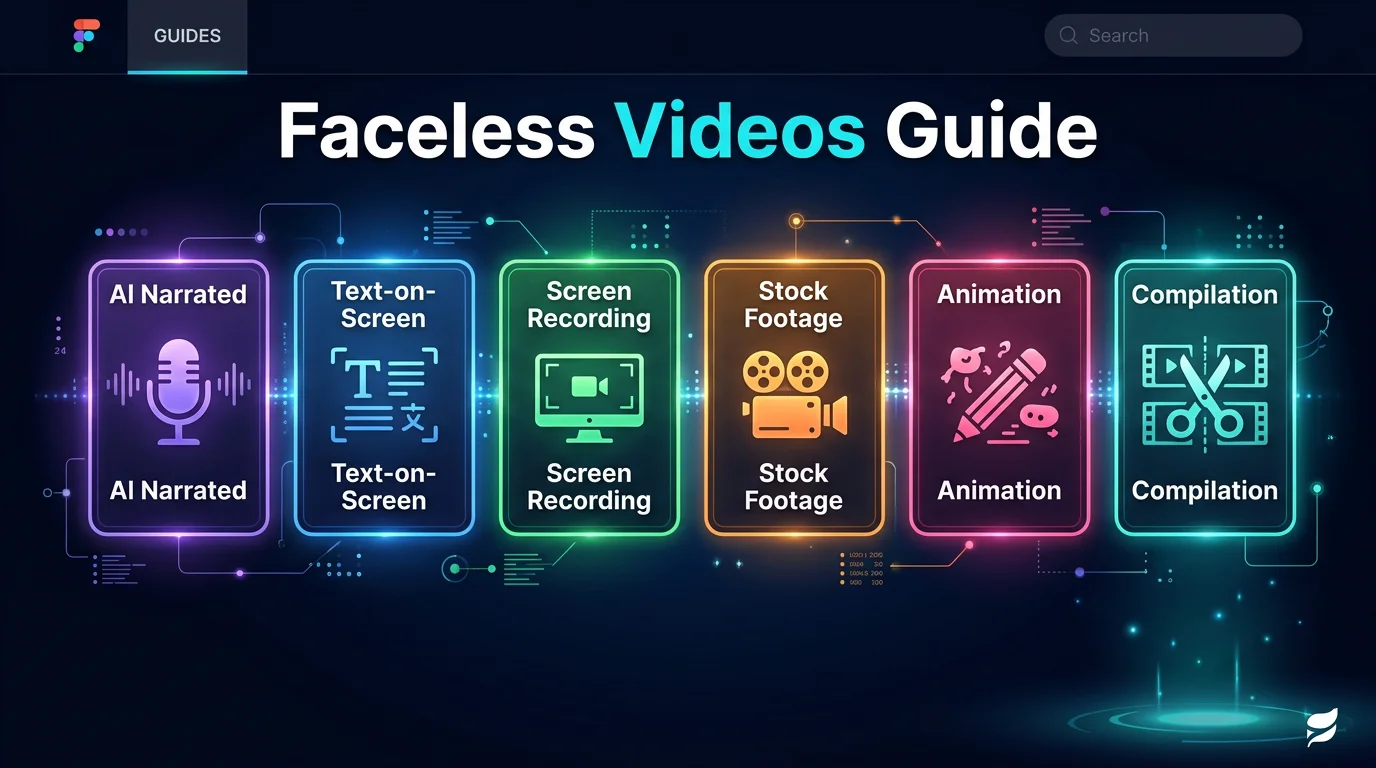
Not all faceless content looks the same. Here are the six main types you''ll encounter, each with different strengths, difficulty levels, and ideal platforms.
1. AI-Narrated with Visuals
This is the most popular type of faceless video in 2026. An AI voice reads a script while AI-generated images, stock footage, or custom visuals play on screen. The videos typically include animated captions, background music, and transitions.
Best platforms: YouTube Shorts, TikTok, Instagram Reels
Example niches: Motivation, Stoicism, psychology facts, scary stories, finance tips
Difficulty: Easy (especially with AI tools)
Why it works: High production value with minimal effort. AI voices have become nearly indistinguishable from human narration, and AI image generators produce stunning visuals in seconds.
2. Text-on-Screen / Quote Reels
The simplest faceless format. Text appears over a background — either a static image, a looping video, or a gradient. Think motivational quotes, daily tips, fun facts, or hot takes displayed as bold text with music.
Best platforms: Instagram Reels, TikTok
Example niches: Quotes, relationship advice, fun facts, book summaries
Difficulty: Very easy
Why it works: Extremely fast to produce. You can batch-create dozens in an hour. Great for building a following quickly, though monetization per video is lower.
3. Screen Recordings
You record your screen while demonstrating software, browsing the web, playing a game, or walking through a tutorial. Voiceover (your real voice or AI) explains what''s happening.
Best platforms: YouTube (long-form and Shorts)
Example niches: Tech tutorials, software reviews, AI tool demos, gaming
Difficulty: Easy to medium
Why it works: Incredibly authentic. Viewers trust screen recordings because they can see exactly what you''re talking about. Tech and software niches tend to have high CPMs too.
4. Stock Footage with Voiceover
You write a script, record (or generate) a voiceover, and layer it over relevant stock footage clips. This is the classic documentary-style approach adapted for short-form content.
Best platforms: YouTube (both formats), Facebook Reels
Example niches: History, true crime, nature, travel, science explainers
Difficulty: Medium (requires good editing and footage selection)
Why it works: Feels professional and premium. Stock footage libraries like Pexels and Storyblocks give you access to millions of clips for free or cheap.
5. Whiteboard / Animation
Animated explainer videos where concepts are illustrated through drawings, motion graphics, or character animations. Think channels like Kurzgesagt''s style, but simplified for short-form.
Best platforms: YouTube, TikTok
Example niches: Education, science, how things work, business concepts
Difficulty: Hard (requires animation skills or specialized tools)
Why it works: Extremely engaging and shareable. Animated content stands out in feeds dominated by live-action. However, production time is significantly higher than other formats.
6. Compilation / Reaction
You curate clips from other sources — sports highlights, funny moments, product demos, news clips — and add commentary via text or voiceover. Reaction-style content where you comment without showing your face also fits here.
Best platforms: YouTube, TikTok, Facebook Reels
Example niches: Sports highlights, product reviews, news commentary, "top 10" lists
Difficulty: Easy to medium
Why it works: Leverages existing content that already has proven engagement. The key is adding genuine value through curation and commentary, not just re-uploading.
Faceless Videos by Platform
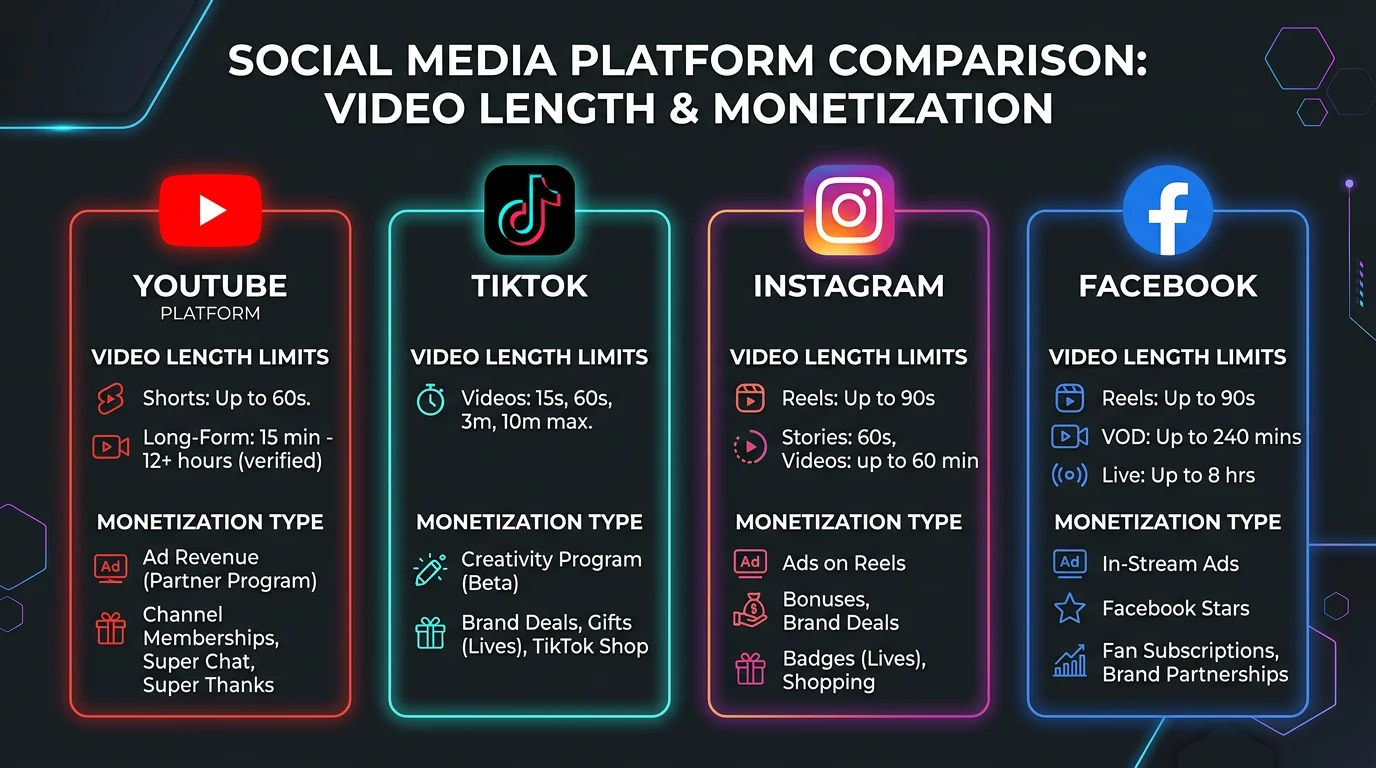
Each social platform treats faceless content differently. Here''s what you need to know about creating faceless videos for each one.
YouTube (Shorts + Long-Form)
YouTube is the best platform for long-term faceless video income. It''s the only major platform where you can earn significant ad revenue from short-form content through the YouTube Partner Program. YouTube Shorts now share in ad revenue, and long-form faceless videos can earn $5-30+ CPM depending on your niche.
YouTube also has the best search discoverability. Your videos can rank in YouTube search and Google search for years, generating passive views long after you publish them. To get started, you''ll need to meet the YouTube monetization requirements: 1,000 subscribers and either 4,000 watch hours or 10 million Shorts views in 90 days.
Create Faceless Videos on Autopilot
FlowShorts generates and posts AI videos to YouTube, TikTok & Instagram while you sleep.
Try FlowShorts Free →For a detailed walkthrough, see our guide on how to make faceless YouTube videos, or explore faceless YouTube channel ideas if you''re still deciding on a topic.
TikTok
TikTok offers the best viral reach for new creators. The algorithm surfaces content based on engagement, not follower count, so a brand-new faceless account can get millions of views on its first video. TikTok''s Creator Rewards Program pays creators for views on videos over one minute, making longer faceless content increasingly profitable.
Faceless content thrives on TikTok in niches like psychology, motivation, scary stories, and AI-generated content. The platform''s audience tends to be younger and more trend-driven, so staying current matters. Check out our faceless TikTok ideas guide and learn how to make money on TikTok for specifics.
Instagram Reels
Instagram Reels is the best platform for community building and brand deals. While direct ad revenue is lower than YouTube, Instagram''s engaged audiences make it ideal for selling products, landing affiliate partnerships, and securing sponsored content deals.
Faceless Reels work particularly well for quote pages, aesthetic content, niche education, and product recommendations. Instagram''s audience tends to be slightly older and more purchase-ready than TikTok''s. For tips straight from the platform, see Instagram''s official Reels guide. We also have a deep dive on how to make faceless Reels and how to monetize faceless Reels.
Facebook Reels
Facebook Reels is the emerging opportunity with less competition. Most creators ignore Facebook, which means less saturation and surprisingly strong reach for faceless content. Facebook''s audience skews older (30-55), which is ideal for niches like finance, health, history, and motivational content where older demographics have higher purchasing power.
Monetization comes through Facebook''s ad revenue sharing program, and the barrier to entry is lower than YouTube. If you''re already creating faceless Shorts or Reels, cross-posting to Facebook is essentially free distribution.
Platform Comparison
| Platform | Video Length | Monetization | Best For |
|---|---|---|---|
| YouTube Shorts | Up to 3 min | Ad revenue share | Long-term passive income |
| YouTube Long-Form | 8-20+ min | Ad revenue (highest CPM) | Search traffic, high RPM niches |
| TikTok | Up to 10 min | Creator Rewards Program | Viral reach, new audiences |
| Instagram Reels | Up to 3 min | Brand deals, affiliate | Community, product sales |
| Facebook Reels | Up to 3 min | Ad revenue share | Older demographics, low competition |
How to Create Faceless Videos with AI
Here''s the step-by-step process for creating faceless videos from scratch using AI tools. This workflow applies to all platforms.
Step 1: Choose Your Niche
Pick a topic area that has proven demand and strong monetization potential. The best faceless niches combine high search volume, engaged audiences, and either high ad CPMs or clear product/affiliate opportunities. Don''t pick a niche just because you like it — validate that people are actually searching for and watching this type of content. Our free niche finder tool can help you evaluate options.
Step 2: Write or Generate a Script
Every great faceless video starts with a strong script. You can write your own, use AI to generate one, or combine both approaches. A good script has a hook in the first 2-3 seconds, delivers value throughout, and ends with a reason to follow or watch more. For short-form content, aim for 100-180 words (40-70 seconds of narration). Use our free video script generator to get started, and read our guide on the best hooks for short-form videos to nail your opening lines.
Step 3: Generate Voiceover
Use a text-to-speech (TTS) tool to turn your script into natural-sounding narration. In 2026, AI voices are remarkably realistic — most viewers can''t tell the difference. Popular options include ElevenLabs, OpenAI TTS, and built-in voices from video creation platforms. Choose a voice that matches your niche: deep and authoritative for finance, warm and calm for motivation, energetic for entertainment.
Step 4: Create Visuals
Generate or source the visuals that will accompany your narration. Options include AI image generators (like Midjourney, DALL-E, or Flux), stock footage libraries (Pexels, Storyblocks), or screen recordings. For short-form faceless content, AI-generated images with subtle motion effects (Ken Burns zoom/pan) are the most popular and efficient approach.
Step 5: Add Captions and Music
Captions are non-negotiable in 2026. The majority of social media videos are watched without sound initially, and animated TikTok-style captions dramatically increase watch time and engagement. Add royalty-free background music that matches your content''s mood — subtle enough to not overpower the narration, but present enough to create atmosphere.
Step 6: Render and Post
Compile everything into a vertical 1080x1920 video (9:16 aspect ratio). Export at high quality, then upload to your target platforms. For maximum reach, post consistently — daily if possible — and optimize your titles, descriptions, and hashtags for each platform''s algorithm.
For platform-specific walkthroughs, see our guides on how to make faceless Reels and how to make faceless YouTube videos.
Best Niches for Faceless Videos
Niche selection is the single most important decision you''ll make. Here are the top 10 niches for faceless videos in 2026, ranked by a combination of demand, competition, and monetization potential.
| Niche | Estimated CPM | Best Format | Difficulty |
|---|---|---|---|
| Personal Finance | $15-30 | AI narration + visuals | Medium |
| Motivation / Stoicism | $5-12 | AI narration + visuals | Easy |
| Psychology / Self-Improvement | $8-18 | AI narration + visuals | Easy |
| Tech / AI Tools | $12-25 | Screen recordings | Medium |
| History / Documentaries | $6-14 | Stock footage + voiceover | Medium |
| Horror / Scary Stories | $4-10 | AI narration + visuals | Easy |
| Health / Fitness | $10-20 | Stock footage + text | Medium |
| Science / Space | $6-15 | Stock footage + animation | Hard |
| Business / Entrepreneurship | $12-25 | AI narration + visuals | Medium |
| Cooking / Recipes | $5-12 | Overhead footage | Easy |
Create Faceless Videos on Autopilot
FlowShorts generates and posts AI videos to YouTube, TikTok & Instagram while you sleep.
Try FlowShorts Free →For deeper analysis, check out our guides on top faceless YouTube niches and best niches for faceless Reels.
How to Monetize Faceless Videos
Faceless videos can generate income through five main channels. Most successful creators combine two or three of these.
1. Platform ad revenue — YouTube ad revenue share is the most straightforward. Faceless channels in high-CPM niches like finance and tech can earn $5,000-20,000+ per month from ads alone.
2. Affiliate marketing — Recommend products in your niche and earn commissions. This works especially well for tech, software, and product review channels. Link in bio on Instagram and TikTok, or in YouTube descriptions.
3. Digital products — Sell ebooks, courses, templates, or presets related to your niche. Your faceless channel becomes the traffic engine.
4. Brand deals and sponsorships — Even faceless channels get sponsorship offers. Brands care about your audience demographics, not whether you show your face. Instagram is particularly strong for this.
5. Account flipping — Build a faceless channel to a certain size, then sell it. Because the brand isn''t tied to your identity, faceless accounts are worth more on marketplaces than personal brands.
We cover monetization strategies in depth in our guides on monetizing faceless Reels and making money on TikTok.
Best Tools for Making Faceless Videos
Here are the top tools for creating faceless videos in 2026, compared across features that matter most. For a comprehensive breakdown, see our best faceless video generators with auto-posting comparison.
| Tool | Type | Auto-Post | Starting Price | Best For |
|---|---|---|---|---|
| FlowShorts | AI video generator | Yes (YT, TT, IG) | $19/mo | Full autopilot faceless channels |
| InVideo AI | AI video editor | No | $25/mo | Long-form AI video creation |
| Opus Clip | Clip repurposer | No | $19/mo | Repurposing long videos into Shorts |
| CapCut | Video editor | No | Free | Manual editing with templates |
| Canva | Design + video | Yes (limited) | Free / $13/mo | Simple text-on-screen videos |
| Pictory | Script-to-video | No | $23/mo | Blog-to-video conversion |
| Fliki | AI video generator | No | $28/mo | Text-to-video with stock footage |
| Revid.ai | AI Shorts generator | No | $19/mo | Quick short-form generation |
The right tool depends on your workflow. If you want a fully automated system that generates and posts videos on a schedule without any manual work, look for platforms with built-in auto-posting to YouTube, TikTok, and Instagram. If you prefer hands-on control, a combination of an AI script generator + video editor like CapCut gives you maximum flexibility.
Are Faceless Videos Worth It?
Here''s an honest assessment.
The pros are compelling: You maintain complete privacy. You can run multiple channels simultaneously. Faceless channels are sellable assets (unlike personal brands). You don''t need a camera, lighting, or makeup. AI tools have made production faster and cheaper than ever. And the demand for short-form video content is still growing rapidly in 2026.
The cons are real too: It''s harder to build a deep personal connection with your audience. Some niches (fitness transformations, beauty tutorials, day-in-my-life) simply don''t work well without a face. YouTube''s algorithm may scrutinize AI-heavy content more closely, so quality and originality matter more than ever. And the barrier to entry is now so low that competition in popular niches is fierce.
The honest answer: yes, faceless videos are absolutely worth it in 2026 — if you pick the right niche, focus on quality over quantity, and stay consistent. The creators who fail aren''t failing because the format doesn''t work. They''re failing because they quit after two weeks or choose oversaturated niches without adding any unique angle.
Frequently Asked Questions
Are faceless videos profitable?
Yes. Faceless YouTube channels in niches like finance, motivation, and tech regularly earn $2,000-$20,000+ per month from ad revenue alone. When you add affiliate income, digital products, and brand deals, the ceiling is even higher. Profitability depends on your niche, consistency, and content quality — not whether you show your face.
How do I make faceless videos for free?
You can create faceless videos for free using CapCut (free video editor with templates and captions), Pexels (free stock footage), and free AI voice generators. The quality will be lower than paid tools, and you''ll spend more time on manual editing, but it''s a viable way to start and validate your niche before investing in premium tools.
Which platform is best for faceless videos?
YouTube is best for long-term income (highest ad revenue and evergreen search traffic). TikTok is best for fast growth (algorithm favors new creators). Instagram is best for monetization through products and brand deals. Ideally, create for one primary platform and cross-post to the others.
Can faceless YouTube channels get monetized?
Yes. YouTube does not require you to show your face to join the Partner Program. You need 1,000 subscribers and 4,000 watch hours (or 10 million Shorts views in 90 days). Thousands of faceless channels are currently monetized. The key is creating original, valuable content — not just reposting AI-generated filler.
What equipment do I need for faceless videos?
At minimum, you need a computer and an internet connection. That''s it. No camera, no microphone (AI voices handle narration), no lighting, no studio. If you prefer recording your own voiceover, a basic USB microphone ($30-50) will give you better quality than AI voices, but it''s entirely optional in 2026.
Start Creating Faceless Videos Today
Faceless videos are not a trend — they''re a fundamental shift in how content gets created. The tools are better than ever, the platforms are rewarding this content, and the audiences are massive. The only question is whether you''ll start now or wish you had six months from now.
Pick your platform, choose your niche, and publish your first video this week. Use FlowShorts if you want the fastest path — it handles scripts, visuals, voiceover, captions, and auto-posting so you can focus on growing your audience instead of editing videos.
Ready to go deeper? Here are our platform-specific guides:
- How to Make Faceless YouTube Videos
- How to Make Faceless Instagram Reels
- Faceless TikTok Ideas
- How to Start a Faceless YouTube Channel
- Best Faceless Video Generators with Auto-Posting
Free Tools
- Faceless Niche Finder — Evaluate niche ideas by demand and competition
- Video Script Generator — Generate ready-to-use video scripts with AI
- Faceless Reels Generator — Create faceless Instagram Reels ideas for any niche